Why Your Off-Road Caravan, Camper or Trailer Should Stick with the Classics: Solid Axle and Leaf Springs
We're diving into the nitty-gritty of why a solid axle with leaf springs is the way to go over fancy independent suspension with coil springs for your off-road rig.
When preparing for off-road travel with a camper trailer, suspension design is one of the most important considerations. It directly influences durability, reliability, and the ability of the trailer to withstand harsh terrain over long distances.
In recent years, independent suspension systems with coil springs have become popular, often promoted for their modern appearance, improved ride comfort, and flatter cornering characteristics. While these features are beneficial for passenger vehicles, they are largely irrelevant for trailers and heavy-duty work vehicles such as trucks, buses, traditional bakkies and military vehicles. There are good reasons why vehicles like the Toyota Land Cruiser 70 Series still use a solid axle with leaf springs in the rear.
Reliability in Harsh Conditions
Reliability is the most important factor when travelling off the beaten path. Remote environments leave little room for complex systems that require frequent maintenance or specialised parts.
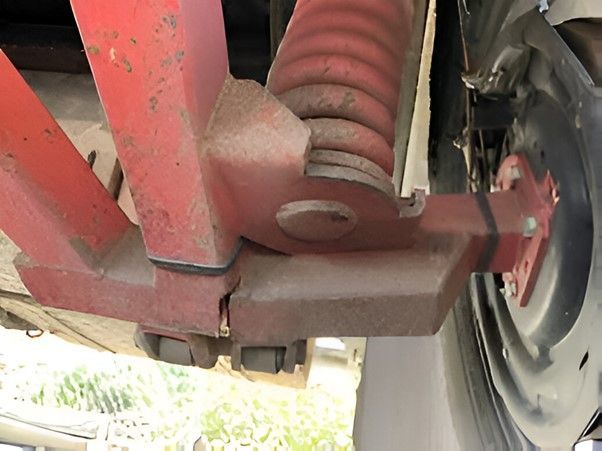
Solid axles combined with leaf springs offer a simple and extremely robust solution. With fewer moving components than independent suspension systems, there are fewer parts that can wear out or fail. Components such as control arms, ball joints, and multiple bushings — common in independent systems — are simply not present.
Over the long term, solid axles also maintain wheel alignment more consistently, ensuring that the trailer continues to track straight and true even after extensive off-road use.
Strength and Durability
A solid axle is inherently strong. Because both wheels are connected by a single axle housing, loads are distributed across a stronger structure than the individual suspension arms found in independent systems.
This design has proven itself over decades in demanding applications ranging from commercial transport to military logistics. When a trailer is subjected to rough tracks, rocks, and heavy loads, structural strength becomes far more important than ride refinement.
The Practical Advantages of Leaf Springs
Leaf springs may appear old-fashioned, but they offer several practical advantages for trailers.
One of the most important is their naturally progressive behaviour under load. As additional weight is placed on the trailer, more leaves in the spring pack engage, effectively increasing the spring rate. This allows the suspension to accommodate both lightly loaded and heavily loaded conditions without requiring complex components.
Leaf springs also perform several functions simultaneously. In addition to supporting the load, they locate the axle and provide a degree of natural damping through friction between the spring leaves. This inherent simplicity makes them particularly well suited to off-road trailers where durability and ease of maintenance are essential.
Lower Cost and Simpler Maintenance
Another advantage of the solid axle and leaf spring configuration is cost. The system is simpler to manufacture, maintain, and repair compared with independent suspension designs that incorporate multiple control arms, bushings, and linkages.
For owners, this translates into lower long-term maintenance costs and easier field repairs if something does go wrong during a trip.
The Role of Shock Absorbers
Shock absorbers are commonly used on modern trailers, but their role is often misunderstood. In motor vehicles, shocks are essential to control wheel movement and keep the tyres in contact with the road surface during cornering and braking.
For a two-wheel trailer, the dynamics are very different. The geometry of the axle and the mass of the trailer naturally limit wheel movement. Leaf springs also provide some inherent damping characteristics through internal friction between the leaves.
We fit shock absorbers to our trailers but their only purpose is to reduce vibrations and improve long term structural integrity.
A Real-World Example
The importance of durability becomes particularly clear in extreme conditions. An acquaintance who operates an overland touring business once arranged a self-drive expedition through parts of Africa including the Serengeti, the Congo and Namibia. For one trip, clients requested off-road caravans instead of the usual lodge-based travel.
Ten well-known off-road caravans with independent suspension systems and shock absorbers were hired for the journey. None of them completed the trip. Due to suspension and structural failures, the caravans were eventually abandoned in the Congo before returning to South Africa.
While this example is extreme, it illustrates the challenges that complex suspension systems can face in very harsh environments.
Proven Simplicity
Solid axles with leaf springs may not attract attention in the same way as more modern suspension systems. However, when reliability, strength, and serviceability are the primary concerns, their advantages remain difficult to match.
For off-road camper trailers that must travel long distances on rough terrain, proven simplicity often delivers the best real-world performance.